Mostrando entradas con la etiqueta Alexa. Mostrar todas las entradas

jueves, 12 de mayo de 2016

Google is giving away the tool it uses to understand language, Parsey McParseface


Yes, to get you to pay attention to what would otherwise be a fairly dense and nerdy thing, Google is using an homage to Boaty McBoatface for one of the software tools it's releasing today. But don't just laugh (or groan) at the name, what Google is giving developers and researchers access to is a big deal. Today, it's open-sourcing something it calls SyntaxNet and a component for it, Mr. McParseface. These are some of the tools that Google uses to understand natural language when you type it into a box or speak to Google Now.
SyntaxNet is the overall framework for parsing sentences, called a "syntactic parser." Parsey McParseface is the English language plug-in for SyntaxNet. Google claims that it can correctly identify the subjects, objects, verbs, and other grammatical building blocks of sentences as well (or, in some cases, better) as trained human linguists — achieving 94 percent accuracy on English-language news articles.
Understanding the grammatical structure of a sentence is key to helping computers act on their meaning. For a simple example, you might say "Give me the time in Paris." Depending on how you parse that sentence, it could mean "Tell me what time it is in Paris" or it could mean "When I am in Paris, tell me what time it is." Being able to even determine which of those meanings is the intended one is a super complicated process for a computer — and it can't even start unless it's able to parse the different grammatical parts of the sentence.
To figure it out, Google says that "SyntaxNet applies neural networks to the ambiguity problem" and then uses "Beam Search" to apply probabilities to multiple possible meanings at the same time before landing on the correct meaning.
Google has been on an open-sourcing tear with its machine learning platform, TensorFlow. After open sourcing it last year and then letting researchers get the piece that lets it use multiple computers, now it's putting out these other components that are built on that same platform. Google says that the "release includes all the code needed to train new SyntaxNet models on your own data, as well as Parsey McParseface, an English parser that we have trained for you and that you can use to analyze English text."

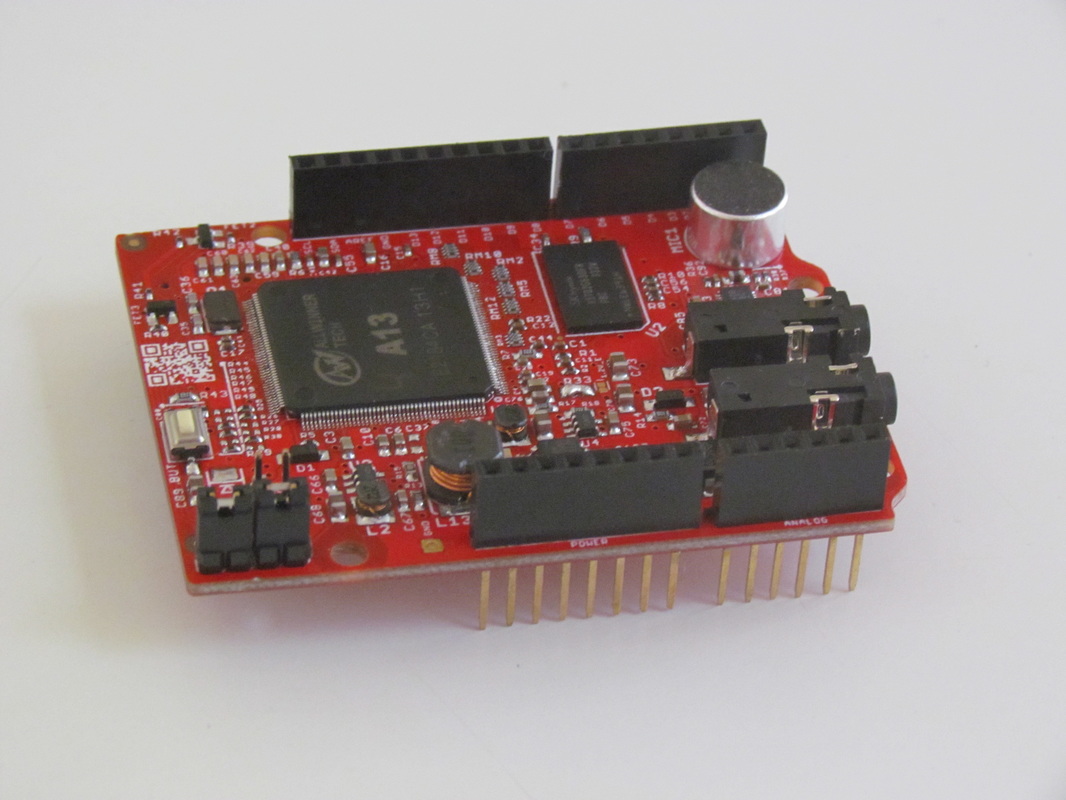
    Arduino shield goes all Siri-like


    Check this one out. Arduino now has a standalone voice recognition and synthesiser, and apparently it doesn’t require an internet connection or cloud-based processing.


    It is a hardware shield which is claimed to be ‘Siri-like’ – it will recognise full sentences and has a 2GB internal dictionary. It can be programmed to identify almost any complete English sentence and build a dialogue system to change its vocabulary.

    Audeme is the company behind the MOVI Arduino shield, which is voice recognition system that is not cloud-based and uses 200 customisable sentences.

    MOVI Voice Control for Arduino adds what the developers call “full sentence recognition capability” to an Arduino maker design project.

    The add-on m
    odule is an off-line speech recognizer and voice synthesizer, which the developer says can recognise several hundreds of user defined sentences, and does not require an internet connection or an auxiliary PC.
    Power consumption is under 3W.
    The device, which was funded by a successful Kickstarter campaign last year, will respond in the same way to a repeated sentence every time, no matter who is talking to it, while its programmable ‘call sign’ means users can personalise the device to their project.
    MOVI is stackable, with connections from the header pins.
    Audeme is a Californian company founded by Gerald Friedland and Bertrand Irissou at the University of California at Berkeley.

    Siri Creators Introduce New AI Assistant Viv


    One of the creators of the artificial intelligence (AI) behind Siri, the digital assistant acquired by Apple in 2010, today demonstrated a next-generation AI called Viv that he said could eventually let people "converse" with any smart device in the Internet of things.

    Siri creator Dag Kittlaus currently runs a San Jose startup called Viv Labs, founded with fellow Siri creator Adam Cheyer. (Another Siri creator, Tom Gruber, now works for Apple.) At the Disrupt NY 2016 tech conference in New York today, Kittlaus gave a live demonstration of his company's latest creation, Viv ("viv" comes from Latin word, "vivus," which means "alive").

    Kittlaus said Viv represents the next "new paradigm" for how people interact with computers. The technology's unique character comes from its use of dynamic program generation, an intelligent method for creating software on the fly depending upon the intent of a user's request.

    'Software That's Writing Itself'
    "We're going to use this technology to breathe life into the inanimate objects and devices of our life through conversation," Kittlaus said during his demonstration. Kittlaus gave several spoken queries to Viv during the presentation and received quick and accurate answers even to complex questions like, "Will it be warmer than 70 degrees near the Golden Gate Bridge after 5 p.m. the day after tomorrow?"

    Unlike other intelligent assistants Viv uses a "computer science breakthrough" that -- after using speech recognition and determining a user's intent based on the words spoken -- automatically creates a software program to produce an accurate and relevant response to a question or request, Kittlaus said.

    "This is software that's writing itself," Kittlaus said. The process, which takes just 10 milliseconds or so, enables Viv to scale in ways that other digital assistants currently cannot, he added.

    Viv's Goal? 'Ubiquity'
    Viv Labs plans to begin launching its AI toward the end of the year, first through a select group of partner, Kittlaus told TechCrunch editor-in-chief Matthew Panzarino during an on-stage Q&A after the demonstration. Eventually, Viv will be opened up to developers at large to allow them to create a wide range of uses for the technology. Viv can already interact with users and enable transactions such as ordering flowers through ProFlowers or reserving a ride through Uber.

    For consumers, Kittlaus said he envisions Viv becoming "the intelligent interface to everything." For developers, Viv will be the next great marketplace and channel for offering content, commerce and services, he said.

    By enabling people to interact with smart devices through conversation, Viv offers an easier and more natural way to interact with computers than, say, apps do, Kittlaus said. "I think kids will be asking in future, 'How did you get along without your assistant?'" he said.

    Unlike with Siri, Viv Labs has no plans to sell its technology to a larger tech firm. Instead, Kittlaus said his company is in talks with most every major firm in the world to put it on almost every device. "Our goal for this is ubiquity," he said.

    ROGER: ALEXA ON YOUR PHONE


    Roger, an app that lets you send voice messages to your contacts in a walkie-talkie format, has now added third-party integration — starting with Amazon’s Alexa, Dropbox, and Slack.

    The app is currently the only free way to utilize Alexa on your phone; there’s a paid app called Lexi that solely offers access to Alexa’s voice services. But with Alexa on Roger, you now you can access Alexa and throw commands at her on the go — you can check your calendar, control smart home devices, make shopping orders, and more, but not all orders will work.


    Phrases like, “play music,” won’t enable Alexa to begin playing music on your device, and Roger CEO and co-founder Ricardo Vice Santos says that’s an issue on Alexa’s end.

    Dropbox integration is a feature Roger users have been calling for as the app only stores messages for 48 hours. Now, users can have their conversations backed up directly to their Dropbox account for safekeeping.

    For Slack, it works precisely how you think it would. Tap on the Slack icon to send a voice message to someone on the service — you can specify where you want to publish your messages, whether it’s to a group or an individual. Santos says the company is working on a transcribing system, but it’s not going to be a core feature since Roger’s purpose is to push voice communication.

    Perhaps the more interesting feature is how Roger can deal with voicemail.

    “One of the reasons why people don’t like voicemail that much is because it’s actually the only medium that you can’t respond in the same currency, so you can’t respond to a voicemail with a voicemail,” Santos told Digital Trends.


    Once a call is missed and if a voicemail is left, Roger will identify the contact and let you listen to the voicemail through Roger. You can then respond with a voice message to that person through the app. If users don’t have Roger installed, they’ll get a text message with the voice message embedded.

    Developers can build their own integrations with Roger, and users can also build IFTTT recipes to get more mileage out of the app.

    Roger was built by former Spotify engineers and is funded by former Facebook executives. The update is available now — the app recently launched on Android, but debuted on iOS last year.

    Google Is Working On An Amazon Echo Competitor Codenamed "Chirp"


    About two months ago, when Amazon announced two new Alexa-powered devices, the Echo Dot and Echo Tap, many of you voiced the same thought: this is the kind of product Google should be working on. With "OK Google" commands being some of the most powerful voice search and personal assistants on the market, Google shouldn't have a lot of trouble inviting itself into your home and living room or making automation independent from your phone and more integrated with your life.
    At the time, we knew (check Artem's comment) that Google was indeed working on an Echo competitor, codenamed "Chirp," and we were rooting for a Google I/O announcement. It seems that this is actually founded in reality as Recode has now obtained information that verifies the original rumor we heard. According to the site's sources, the device will look like the OnHub routers, but that's where the details become scarce.
    It's likely that the Chirp, which will probably have a different name by the time it hits the market, will be talked about and demoed at I/O next week, but the release date might not be immediate. Recode says the plans are for it to land sometime this year, but there's no indication of the price, other features, or capabilities of the device.
    This, along with Virtual Reality, are purported to be part of Google's big themes for I/O so the event is looking more and more exciting. With Google @Home realistically dead in its original iteration, it's interesting to see what approach Google takes now to sneak into the home and integrate with your lifestyle and the different devices and technologies that are already in it.